How Smart Obstruction-Sensing Edge Terminals Prevent Costly Gate Crusher Accidents
The Physics of Continuous Profile Pressure Wave Detection
A smart safety edge sensor functions as a continuous, tactile bumper strip mounted vertically along the moving edge of a gate panel. The internal architecture of a modern edge profile relies on a flexible, weather-resistant EPDM rubber casing housing an internal air cavity or a pair of conductive, soft-alloy ribbon strips separated by a tiny air gap. When the moving gate edge strikes a physical obstruction—such as a parked car bumper, a wandering pet, or a family member—the rubber casing instantly compresses. This compression forces the internal conductive ribbons to make immediate physical contact, completing a low-voltage electrical circuit in a fraction of a millisecond.
Orchestrating Instant Reverse Commands at the Control Board
The moment the safety edge circuit closes, a localized RF transmitter mounted on the gate panel shoots an encrypted wireless signal straight to the main gate controller chassis. The intelligent microprocessor inside the operator instantly interrupts the active motor run cycle, overriding all closing logic to execute an immediate hard reverse command. Instead of continuing to push forward and crushing the obstruction, the gate system instantly backs away, opening the threshold fully to prevent personal injury or structural property damage. This rapid tactile feedback loop establishes an absolute fail-safe layer that protects your family and assets from mechanical crush hazards.
Complete Operational Immunity to Harsh Weather and Blind Zones
Traditional non-contact safety devices, like infrared photo-eyes or motion radar sensors, are highly vulnerable to environmental interference in outdoor environments. Heavy rain, dense morning fog, driving snow, or dirt kicked up from the tires can easily blind an optical lens, causing the gate to freeze open or fail to recognize an obstruction entirely. Because pressure-sensitive safety edges rely entirely on direct mechanical contact and compression physics, their operational accuracy is completely unaffected by blinding sunlight, atmospheric moisture, or night-time darkness, delivering reliable perimeter defense through any regional weather crisis.
Minimizing Kinetic Strain on Internal Gearboxes and Hinge Pins
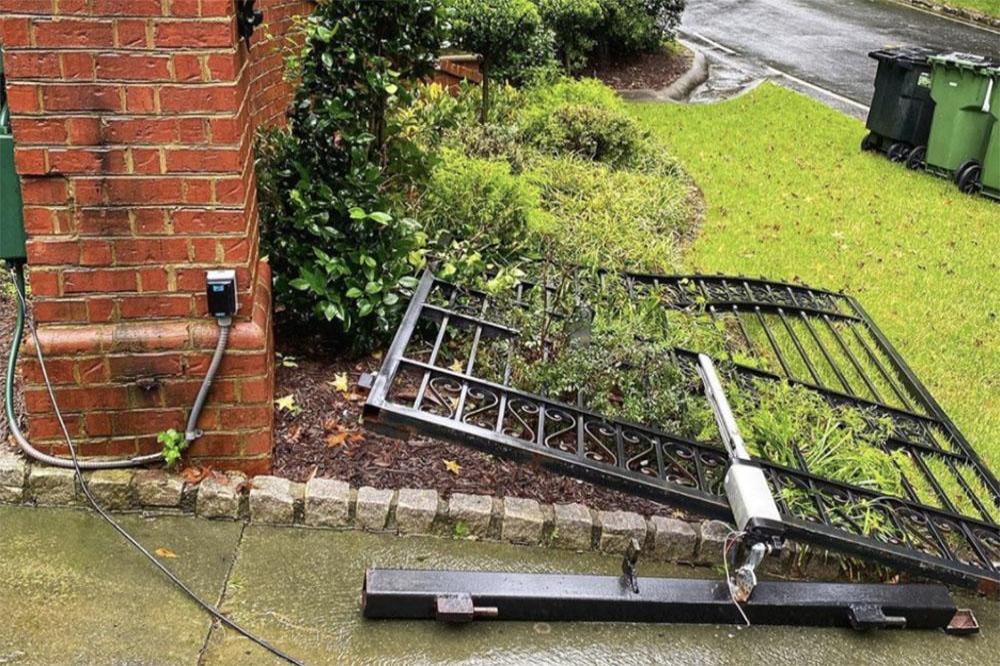
The financial benefit of integrating smart safety edges extends directly to the structural health of your automated machinery. When a heavy gate panel lacks a tactile sensor and strikes a rigid object, the motor will continue to push at full power until its internal current-overload sensors finally trip. This brief window of intense physical resistance sends a violent kinetic shockwave straight back through the entire mechanical assembly, bending heavy-duty hinge pins, warping structural gate framing, and stripping internal nylon drive gears. Stopping a collision at the very first millimeter of physical contact completely eliminates this destructive mechanical strain.
Professional Multi-Point Calibration and Safety Compliance
Because safety edge sensors are vital life-safety devices designed to comply with strict international regulatory codes, professional installation and calibration are essential. Our certified technicians utilize specialized pressure-gauge meters to test the exact amount of physical force required to trigger the reverse cycle, tuning the internal sensitivity thresholds to ensure rapid activation without causing false reversals from heavy wind resistance. Every safety strip is custom-fitted to match the exact height and profile of your gate frame, guaranteeing an unbreachable, responsive safety matrix that keeps your automated entrance operating cleanly and safely for decades to come.