How Smart Loop Detectors Prevent Accidental Vehicle Strikes on Automated Driveway Gates

The Physics of Inductive Ground Loops
Inductive loop detectors operate using the invisible principles of electromagnetism to create an unbreachable safety zone around your gate line. The system consists of an insulated copper wire laid out in a precise geometric pattern—usually a large rectangle—buried just beneath the surface of your concrete, asphalt, or gravel driveway. A specialized digital controller pumps a low-voltage, high-frequency electrical current through this wire, creating a localized magnetic field above the pavement. Because this field is tuned to detect changes in inductance, it acts as a highly sensitive digital scale that constantly monitors the threshold.
Distinguishing Massive Metal Framing from Environmental Debris
The true brilliance of a smart loop detector sits inside its microprocessor control module. When a car, truck, or motorcycle drives over the buried wire, the vehicle's massive steel frame disrupts the electromagnetic field, causing an immediate shift in inductance. The control board instantly processes this digital signature, recognizing the physical presence of a vehicle. Unlike standard motion sensors that can be falsely triggered by blowing autumn leaves, heavy rain, or stray neighborhood animals, an inductive loop reacts exclusively to the metallic mass of a vehicle, completely eliminating frustrating false alarms.
Orchestrating Safety and Reverse Commands Across the Threshold
To provide comprehensive, multi-point perimeter defense, a professional gate installation typically utilizes two distinct types of loop systems working in harmony. The first is the safety loop (or reverse loop), positioned directly inside the swing path of the gate. If a vehicle stops inside this zone, the detector overrides all closing commands, forcing the gate to stay wide open or instantly reverse its travel if it was already moving. The second is the shadow loop, utilized primarily on swing gates. It monitors the dead-space area that the gate panels pass through while moving, ensuring the gate never begins a cycle if a car is tailgating or parked just out of view.
Maximizing System Longevity by Removing Physical Impact Shocks
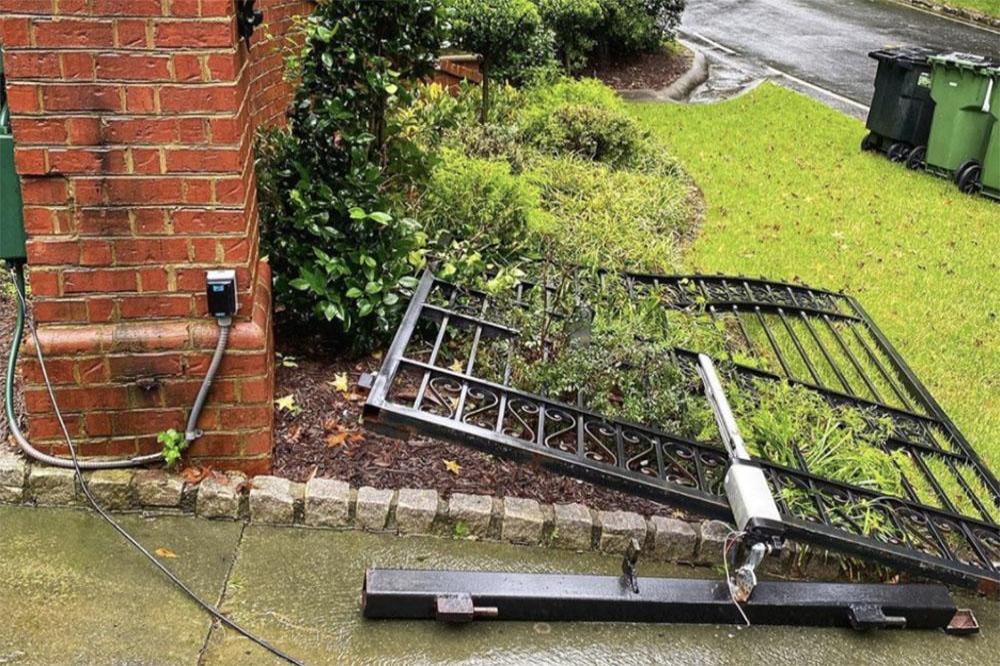
The financial benefit of installing inductive loops extends far beyond avoiding an insurance claim for a scratched car door bumper. When a heavy automated gate strikes a solid object like a vehicle, the physical impact sends a massive shockwave of kinetic energy back through the entire mechanical assembly. This sudden force bends heavy-duty hinge pins, warps structural framing, and can easily strip the internal nylon drive gears or snap the hydraulic valves inside your automatic gate operator. Preventing physical contact entirely preserves the tight structural tolerances of your hardware, keeping your automated system running safely and smoothly.
Precision Saw-Cutting and Environmental Sealing Protocol
Because loop detectors are permanently integrated into your driveway’s physical surface, installation requires specialized equipment and exact engineering. Technicians use industrial diamond-blade walk-behind saws to cut precise, shallow trenches into your pavement. The copper loop wire is wrapped tightly within the track to eliminate internal shifting, and the entire channel is backfilled with a specialized, high-grade flexible polyurethane sealant. This industrial sealant is engineered to withstand extreme shifting temperatures, intense tire weight loads, and moisture penetration, protecting your buried safety matrix for decades to come.